
Disclosure: This post contains affiliate links. I may earn a commission if you buy through them.
Last updated: April 10, 2026
Quick Answer
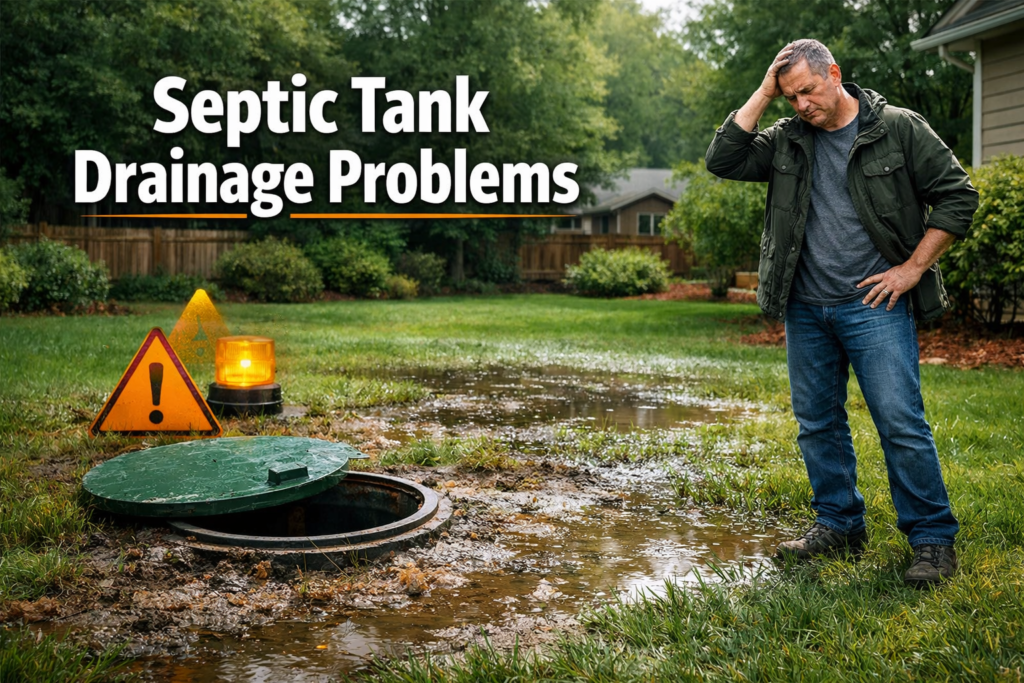
Septic tank drainage problems happen when solids build up, pipes get blocked, drain fields fail, or bacterial activity drops too low to break down waste. The fix depends on the cause: some issues need a pump-out, others need a pipe repair, and many can be prevented with simple monthly maintenance. If you catch the warning signs early, most septic drainage issues are manageable without a costly emergency call.
Septifix: Simple Septic Tank Care in One Tablet
Septifix tablets help break down waste, reduce bad smells, and keep your septic tank working properly. With one easy monthly flush, you can help prevent blockages, protect your plumbing, and avoid costly repairs.
👉 Discover the benefits of using Septifix for hassle-free septic maintenance
Key Takeaways
- Slow drains, gurgling pipes, foul odors, and soggy patches in your yard are the top warning signs of septic drainage failure.
- A full or overloaded tank is the most common cause of drainage problems — most households need pumping every 3 to 5 years.
- Damaged dip pipes and baffles allow solids to escape into the drain field, causing blockages that are expensive to repair.
- Flushing with wipes, grease, or harsh chemicals kills the bacteria your tank needs to function — and accelerates drainage failure.
- Soil composition matters: dense or saturated soil can’t absorb effluent, causing waste to pool in your yard.
- A monthly bacterial treatment tablet (like Septifix Tablets) can restore bacterial balance and prevent slow drains before they become emergencies.
- Manufacturing defects in tanks — such as improperly drilled weep holes — can cause hidden drainage failures that appear to be maintenance problems.
- Never ignore sewage odors indoors: that’s a sign of active backup, not just a maintenance issue.
What Causes Septic Tank Drainage Problems?
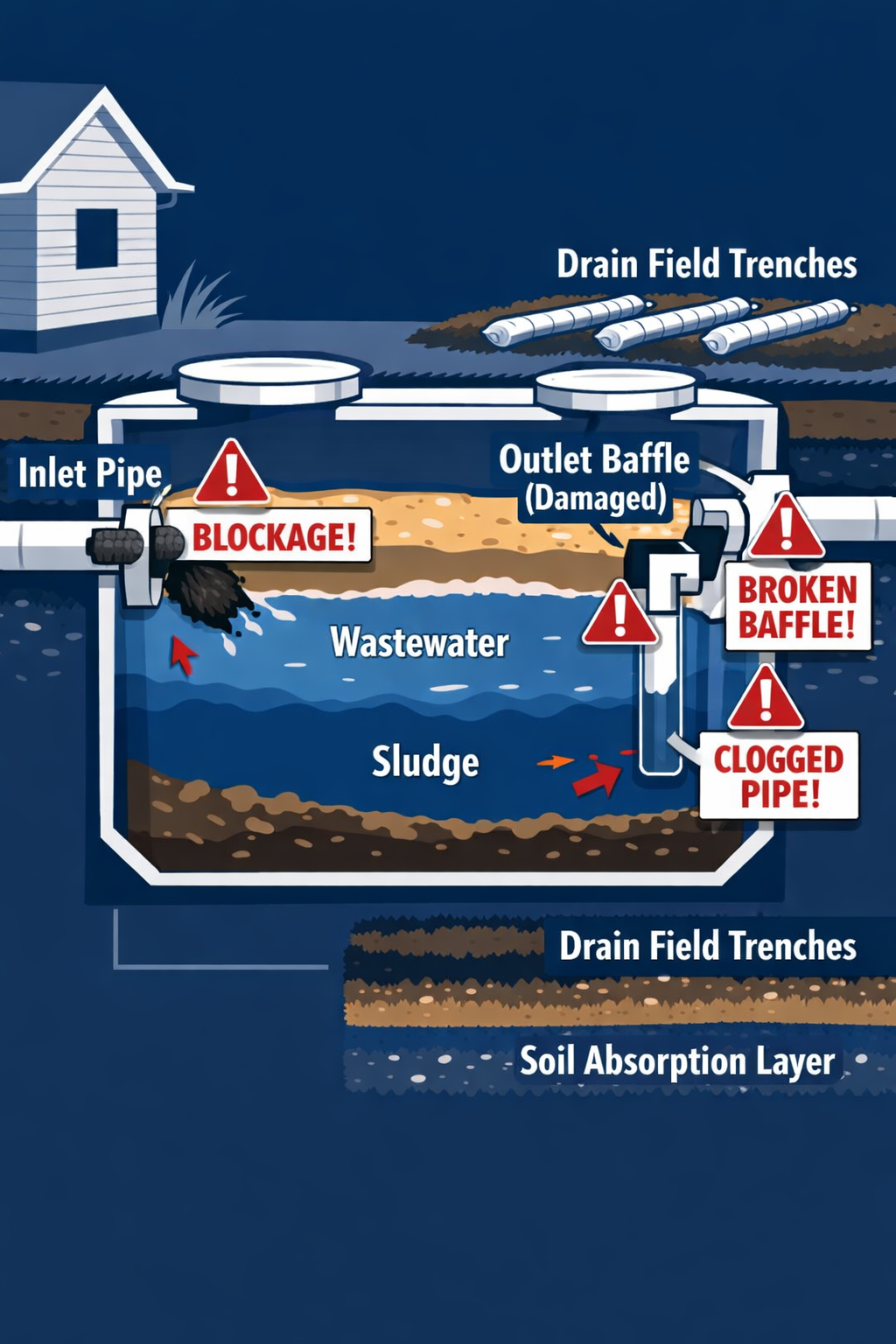
Septic tank drainage problems have several root causes, and identifying the right one saves you time and money. The most common culprits are a full tank, a blocked outlet pipe, a failing drain field, or a drop in bacterial activity inside the tank.
Here’s a breakdown of the most frequent causes:
| Cause | What Happens | Urgency |
|---|---|---|
| Solids escape into the drain field | Solids back up into pipes and drains | High — pump immediately |
| Damaged dip pipe or baffle | Solids escape into drain field | High — call a pro |
| Blocked inlet or outlet pipe | Wastewater can’t flow through | Medium-High |
| Drain field saturation | Soil can’t absorb effluent | High — may need replacement |
| Low bacterial activity | Waste doesn’t break down properly | Medium — treat with bacteria |
| Cracked or collapsed tank | Groundwater enters or sewage escapes | Emergency |
| Ground subsidence | Pressure cracks tank walls | Emergency |
The most overlooked cause: damaged dip pipes. These internal components stop solids from passing into the drain field. They’re most often broken during routine pump-out operations, and once they fail, solids reach the drain field quickly — causing expensive clogs.
Real-world example: In Sannieshof, South Africa, over 200 backed-up septic tanks created 2.7 million liters of raw sewage overflow, contaminating boreholes and flooding residential properties. A single 6,000-liter vacuum truck was the only service vehicle available for the entire area — a stark reminder of what happens when septic drainage maintenance collapses at scale. [1]
How Do I Know If I Have Septic Tank Drainage Problems?
You likely have a septic drainage problem if multiple drains in your home are slow at the same time, you hear gurgling from toilets or pipes, or you notice wet, smelly patches in your yard near the drain field. A single slow drain is usually a pipe clog — but when the whole house drains slowly, the septic system is the likely cause.
Warning signs checklist:
- ✅ All drains in the house are slow (not just one)
- ✅ Toilets gurgle when you run the sink or shower
- ✅ Sewage odors inside the home or near the tank area
- ✅ Wet, spongy, or unusually green grass over the drain field
- ✅ Sewage backing up into the lowest drains (bathtub, basement floor drain)
- ✅ You haven’t had the tank pumped in more than 5 years
For a deeper look at these signals, see our guide on signs your septic tank needs maintenance.
Common mistake: Many homeowners assume a gurgling toilet is a simple plumbing issue and pour drain cleaner down the pipes. Harsh chemical drain cleaners kill the beneficial bacteria in your tank, making the underlying drainage problem worse.
How to Fix Septic Tank Drainage Problems Step by Step
Most septic tank drainage problems can be resolved with a combination of pumping, pipe inspection, and bacterial restoration — in that order.
Step-by-step fix:
- Stop adding water to the system. Reduce laundry, showers, and dishwasher use until the problem is assessed. Overloading a struggling system makes it worse fast.
- Check for obvious blockages. Inspect the inlet pipe from the house to the tank if you can access it safely. A blockage here is a DIY-friendly fix.
- Schedule a pump-out. If the tank is full or close to full, pumping is the first real fix. A professional will also inspect the dip pipes and baffles during this visit.
- Inspect the drain field. If the yard is soggy and the tank isn’t overfull, the drain field may be saturated or clogged. This usually needs a professional assessment.
- Restore bacterial activity. After pumping, reintroduce beneficial bacteria. Septifix Tablets are a convenient monthly treatment that helps restore the microbial balance your tank needs to digest waste efficiently.
- Fix or replace damaged components. Cracked pipes, broken baffles, or a compromised tank wall need professional repair.
For a full walkthrough of what happens when a tank backs up, see what happens when your septic tank backs up.

What Are the Most Common Septic Tank Drainage Problems Homeowners Face?
The three most common septic drainage problems homeowners deal with are: a full tank causing backups, a saturated drain field, and a loss of bacterial activity due to chemical use or neglect. Each has a different fix, so it’s worth identifying which one you’re dealing with before spending money.
Full tank (most common): Solid waste accumulates faster than bacteria can break it down. The tank fills up, effluent has nowhere to go, and the drains slow or back up. Fix: pump the tank and adjust the pumping frequency going forward. Most households need pumping every 3 to 5 years, though the right interval depends on tank size and the number of people in the home. See our complete guide on how often to pump your septic tank.
Saturated drain field: When the soil around the drain field becomes waterlogged — from heavy rain, high water tables, or years of excess effluent — it can no longer absorb liquid. This is one of the costlier problems to fix and may require drain field replacement. In some regions, soil composition makes this problem nearly unavoidable without engineered solutions.
Low bacterial activity: Antibacterial soaps, bleach, and chemical drain cleaners all reduce the bacterial population inside your tank. Without enough bacteria, solids don’t break down, the tank fills faster, and drainage slows. A monthly bacterial additive is the simplest preventive measure you can take. Learn more about why your septic tank needs bacteria.
Can Manufacturing Defects Cause Septic Drainage Problems?
Yes — and this is something most homeowners never think to check. A tank with a structural defect can fail even with perfect maintenance.
In December 2025, a Minnesota concrete manufacturer (Lakes Concrete Plus) was fined $25,000 for selling approximately 1,500 septic tanks with weep holes drilled into them between 2019 and 2022. The holes were intended to prevent freezing, but cannot be adequately sealed for the tank’s lifetime. Minnesota law prohibits weep holes because they allow groundwater to enter the tank, dilute the bacterial environment, and cause drainage failures that look like maintenance problems. The company was required to replace affected tanks.
What this means for you: If you bought a new home or had a tank installed between 2019 and 2022 in the upper Midwest, it’s worth having your tank inspected for structural integrity — especially if you’re experiencing unexplained drainage issues despite regular pumping.
Ground subsidence is another structural risk. Soil movement can place pressure on buried tank walls, causing cracks that let groundwater in or allow sewage to escape into the surrounding soil.
How to Prevent Septic Tank Drainage Problems Long-Term
Preventing septic drainage problems is far cheaper than fixing them. The average septic system can last 25 to 40 years with proper care — but neglect can cut that lifespan dramatically.
Monthly habits that protect your system:
- Use a bacterial treatment tablet each month to maintain a healthy microbial population. Try Septifix Tablets here — they’re designed specifically for monthly use and dissolve slowly to feed bacteria over time.
- Spread laundry loads throughout the week instead of doing multiple loads in one day.
- Never flush wipes (even “flushable” ones), grease, medications, or paper towels. See our full list of what not to put in your septic tank.
- Use septic-safe toilet paper and avoid antibacterial soaps where possible.
Annual and periodic tasks:
- Inspect the tank lid and access risers for damage or settling.
- Check the drain field area for wet spots, odors, or unusually lush grass.
- Have the tank pumped on schedule — don’t wait for symptoms. Use our complete septic tank maintenance checklist to stay on track.
- Have a professional inspect dip pipes and baffles during each pump-out.
Choose professional help if:
- You see sewage surfacing in your yard
- Multiple drains are backing up simultaneously
- You haven’t pumped in more than 5 years and notice any symptoms
- Your tank is more than 20 years old and hasn’t been inspected

FAQ: Septic Tank Drainage Problems
Q: Why are all my drains slow at the same time?
When every drain in the house is slow — not just one — the problem is almost always in the septic system, not the individual pipes. The tank is likely full, the outlet is blocked, or the drain field is saturated.
Q: How often should I pump my septic tank to avoid drainage problems?
Most households need pumping every 3 to 5 years, but a 2-person household with a large tank may go longer, while a large family with a small tank may need annual pumping. The only way to know for sure is to have a professional measure the sludge and scum layers.
Q: Can I use bleach if I have a septic tank?
Occasionally, small amounts of bleach (like a normal load of laundry) won’t destroy your system. But regular heavy use of bleach, antibacterial cleaners, or chemical drain openers will reduce bacterial activity and contribute to drainage problems over time.
Q: What’s the difference between a full tank and a failing drain field?
A full tank causes slow drains throughout the house and often responds quickly to pumping. A failing drain field shows up as wet, soggy ground or sewage odors in the yard — and doesn’t fully resolve with pumping alone because the soil itself can’t absorb liquid.
Q: Can tree roots cause septic drainage problems?
Yes. Tree roots are drawn to the moisture and nutrients near septic pipes and drain fields. They can crack pipes, block flow, and damage the drain field over time. Keep large trees at least 30 feet from your septic system components.
Q: Is it safe to use bacterial additives every month?
Yes — monthly bacterial treatments are safe and beneficial for most septic systems. They replenish the microbial population that gets reduced by everyday household chemical use. Products like Septifix Tablets are formulated specifically for this purpose.
Q: What happens if I ignore septic drainage problems?
Ignoring drainage problems leads to sewage backup into your home, drain field failure, groundwater contamination, and potentially a full system replacement — which can cost $10,000 to $25,000 or more.
Q: Can heavy rain cause septic drainage problems?
Yes. Heavy or prolonged rain saturates the soil around the drain field, reducing its ability to absorb effluent. This is a temporary problem in most cases, but repeated flooding can cause long-term drain field damage.
Q: How do I know if my septic tank has a structural defect?
Signs include unexplained drainage problems despite regular pumping, ground settling or sinkholes near the tank, and sewage odors that don’t resolve. A professional inspection with a camera or dye test can confirm structural issues.
Q: What’s the cheapest way to prevent septic drainage problems?
Consistent habits: pump on schedule, use a monthly bacterial treatment, avoid flushing non-biodegradable items, and spread water use throughout the week. These steps cost very little compared to a drain field replacement.
Conclusion
Septic tank drainage problems rarely appear without warning. Slow drains, gurgling pipes, yard odors, and wet patches are all signals that something needs attention — and the earlier you act, the lower the repair bill. Most issues come down to a full tank, a damaged component, a failing drain field, or depleted bacterial activity. All of these are manageable when caught early.
Your action plan for 2026:
- Check your pumping history. If it’s been more than 3 to 5 years, schedule a pump-out now.
- Start a monthly bacterial treatment. Check the price on Septifix Tablets — a simple monthly habit that keeps bacterial levels healthy and prevents slow drains from becoming emergencies.
- Walk your yard. Look for wet patches, unusually green grass, or odors near the drain field.
- Review what goes down your drains. Use the guide on what not to put in your septic tank as a household reference.
- Book an inspection if your tank is over 20 years old or if you’ve had any unexplained drainage issues.
A well-maintained septic system protects your home, your family’s health, and your property value. The cost of prevention is always a fraction of the cost of repair.
References
[1] Collapse Of Sannieshof Septic Tank Services Creates Man Made Disaster – https://nw.da.org.za/2025/09/collapse-of-sannieshof-septic-tank-services-creates-man-made-disaster
[2] Bemidji Septic System Tank Manufacturer Fined 25000 For Potential Sealing Issue To Offer Tank – https://www.pca.state.mn.us/news-and-stories/bemidji-septic-system-tank-manufacturer-fined-25000-for-potential-sealing-issue-to-offer-tank
[3] Common Septic Tank Problems – https://www.aaturnertankers.co.uk/news/common-septic-tank-problems/
[5] Alabama Sewage Disposal 60 Minutes 2021 12 19 – https://www.cbsnews.com/news/alabama-sewage-disposal-60-minutes-2021-12-19/