

Last updated: March 9, 2026
FYI: Some links in this article may be affiliate links, meaning I may earn a small commission at no extra cost to you if you purchase through them. This never influences my recommendations.
Key Takeaways
- Septifix negative reviews most often cite delayed results, inconsistent effectiveness, and the need for ongoing monthly use.
- The product works best as a maintenance tool for healthy or mildly stressed tanks, not as a fix for severely damaged systems.
- Counterfeit Septifix tablets sold through third-party retailers have caused many negative experiences reported online.
- Results vary significantly depending on tank size, age, and existing condition.
- Shipping takes 5–7 days, which is a problem if you have an urgent septic issue.
- Initial costs can run higher than expected if your tank requires 2–3 tablets for the first treatment.
- Consistent monthly use is required to maintain results; skipping treatments can allow odors and clogs to return.
- Professional pumping or repair should come first if your system is already failing.
- Buying only from the official website reduces the risk of receiving a counterfeit product.
Quick Answer

Most Septifix negative reviews fall into a few clear categories: unrealistic expectations, counterfeit products, and using the tablets on systems that need professional repair first. Septifix is a bacterial additive designed for ongoing maintenance, not a one-time cure. If your tank is in reasonable condition and you use the product consistently and correctly, many homeowners report solid results. But if you’re expecting a quick fix for a failing system, you’re likely to be disappointed.
What Do Septifix Negative Reviews Actually Say?
The most common complaints center on three things: slow or no visible results, the product not fixing serious pre-existing problems, and receiving what appear to be counterfeit tablets.
Digging into the feedback across review platforms, a pattern emerges:
- “Nothing changed” — Users with heavily compromised systems saw little improvement, even after several months of use.
- “Odors came back” — Customers who skipped a monthly treatment reported that drain smells and slow drains returned.
- “Not worth the price” — Some buyers felt the cost was higher than expected once they factored in the 2–3 tablets needed for an initial treatment on a larger tank.
- “Took too long to arrive” — The 5–7 day shipping window frustrated homeowners dealing with active odor or drainage problems.
- “Bought a fake” — A notable subset of negative reviews came from buyers who purchased through Amazon or eBay and received counterfeit or diluted products.
Pull quote: “Many negative Septifix reviews aren’t really about the product itself — they’re about mismatched expectations or counterfeit tablets from unauthorized sellers.”
The honest takeaway: a portion of these complaints are valid product limitations, but a significant share stem from avoidable mistakes like buying from the wrong source or expecting the tablets to replace professional septic service.
Is Septifix a Scam, or Are the Complaints Overstated?
Septifix is not a scam, but some of the marketing language around it sets unrealistic expectations. The product contains bacterial strains and oxygen-releasing compounds designed to support the natural breakdown process inside your tank. For a deeper look at how these treatments function, see our guide on how septic tank treatment works.
The skepticism is understandable. When a product promises to eliminate odors and reduce pumping frequency, homeowners naturally expect dramatic results fast. The reality is more nuanced:
- Bacterial additives work gradually, not overnight.
- They support existing bacterial colonies rather than replacing professional maintenance.
- A tank that needs pumping still needs pumping — no tablet changes that. (See signs your septic tank needs pumping to know when you’ve crossed that line.)
Choose Septifix if: Your tank is in reasonable working condition and you want a simple monthly maintenance habit.
Skip it (for now) if: Your system is backing up, your drain field is failing, or you haven’t had a professional inspection in years.
Why Do Results Vary So Much Between Users?
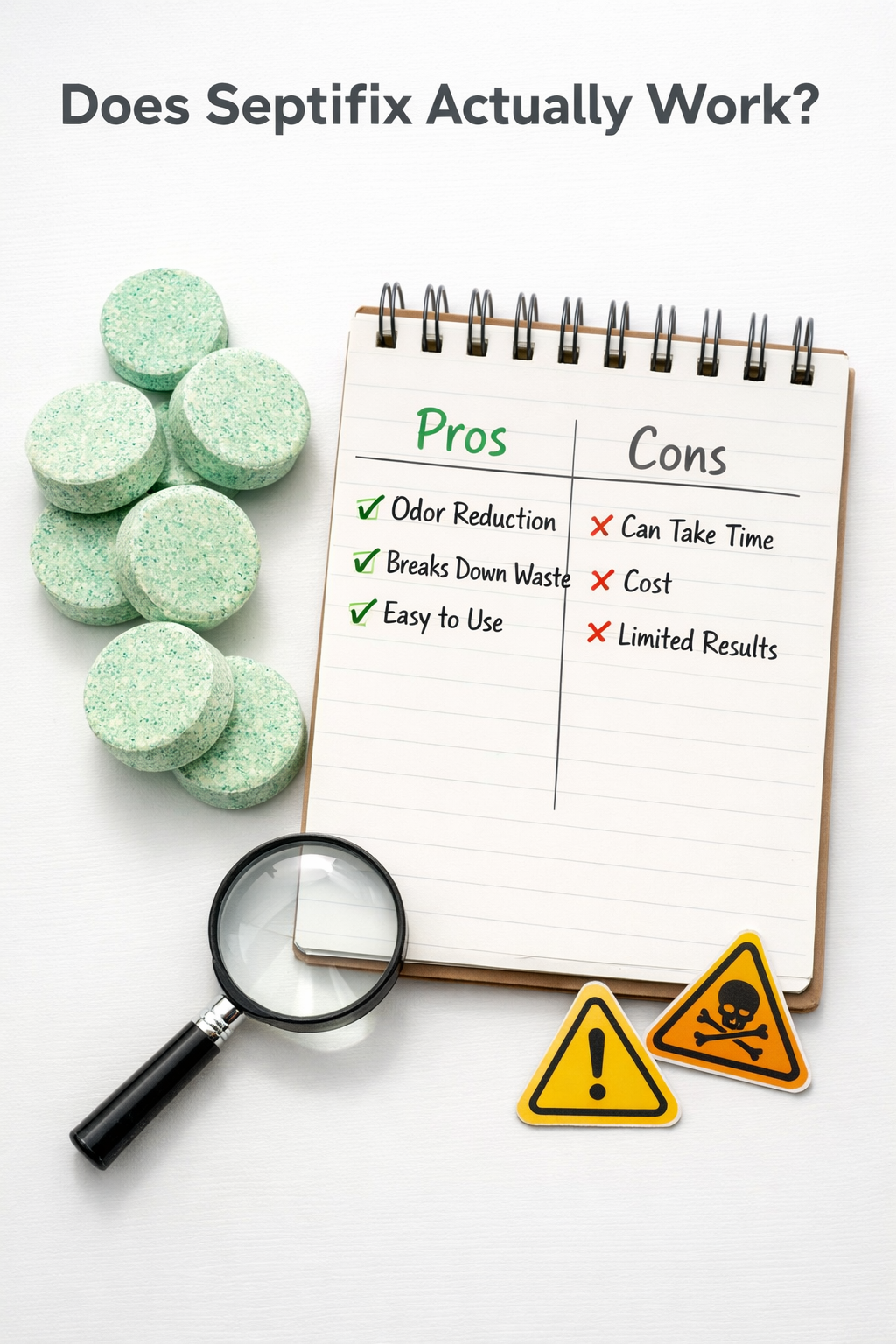
Effectiveness varies significantly based on tank size, age, current bacterial health, and how consistently the product is used. This is the single biggest reason Septifix negative reviews exist alongside equally enthusiastic positive ones.
Here’s what affects outcomes:
| Factor | Effect on Results |
|---|---|
| Tank size | Larger tanks may need 2–3 tablets initially, raising costs |
| Pre-existing damage | Severely compromised systems see little benefit |
| Consistency of use | Skipping months allows problems to return |
| Household water usage | Heavy usage dilutes bacterial colonies faster |
| Presence of antibiotics/chemicals | Harsh cleaners kill beneficial bacteria |
Understanding why your septic tank needs bacteria helps put this in context. Bacterial additives are supplements, not substitutes. If the environment inside your tank is hostile to bacteria (due to bleach overuse, for example), no additive will perform well.
How Do Counterfeit Products Contribute to Septifix Negative Reviews?
A meaningful portion of Septifix negative reviews trace back to counterfeit or low-quality tablets sold through unauthorized channels. Because the product has gained popularity, fake versions have appeared on third-party marketplaces.
These counterfeits cause real problems:
- Recurring odors despite regular use
- Wasted money with no measurable improvement
- Damage to trust in the product category overall
Septifix is sold exclusively through its official website to address this issue. That’s inconvenient for buyers who prefer Amazon, but it does reduce the counterfeit risk. If you’ve had a bad experience and bought from a third-party seller, there’s a real chance the product you received wasn’t genuine.
Practical rule: If the price seems unusually low or the seller isn’t the official Septifix site, treat it as a red flag.
If you want a simple, consistent option for monthly maintenance, 👉 see how Septifix tablets can keep your septic system clean and efficient — but always purchase from the official source.
What Are the Legitimate Limitations of Septifix?
Even setting aside counterfeits and misuse, Septifix has real limitations worth knowing before you buy.
1. It requires ongoing commitment.
This isn’t a one-and-done treatment. Skipping months means the bacterial population inside your tank declines, and problems can return. Think of it like a probiotic — consistency matters.
2. It won’t fix structural problems.
If your drain field is saturated, your baffles are broken, or your tank is cracked, no bacterial tablet will help. You need a professional first. Our guide on what happens if your septic tank is full explains why delaying professional service makes things worse.
3. Shipping delays are real.
The 5–7 day shipping window means you shouldn’t order Septifix in a crisis. Order it when things are fine and keep a supply on hand.
4. Upfront costs can be higher than advertised.
If your tank is larger or hasn’t been treated recently, the first month may require 2–3 tablets rather than one, increasing your initial spend beyond the standard per-tablet price.
How Should Homeowners Use Septifix to Avoid These Problems?

Used correctly, many of the issues in Septifix negative reviews are avoidable. Here’s a straightforward approach:
- Get a professional inspection first. Before starting any additive, know the actual condition of your tank. See what happens during a septic inspection to understand what to expect.
- Pump if needed. If your tank is overdue for pumping, do that before adding bacterial treatments. Additives work best in a clean environment.
- Order in advance. Don’t wait for a problem. Keep a 2–3 month supply so shipping delays never leave you without a treatment.
- Follow the dosage for your tank size. Larger tanks need more product upfront. Read the label carefully.
- Use it every month without skipping. Set a calendar reminder. Consistency is what separates positive reviews from negative ones.
- Avoid harsh chemical drain cleaners. These kill the bacteria you’re paying to introduce. For broader maintenance habits, our complete septic tank care routine guide is a solid reference.
Are There Better Alternatives to Septifix?
Septifix isn’t the only bacterial additive on the market, and for some homeowners, a different product or approach may work better.
Alternatives to consider:
- Other enzyme-based tablets — Similar mechanism, different bacterial strains. Results vary by brand and tank condition.
- Liquid bacterial treatments — Some homeowners prefer liquid formulas for faster dispersion, though shelf life can be shorter.
- Yeast-based treatments — An old DIY approach (flushing active dry yeast) that provides some bacterial support at very low cost, though with less consistency.
- Professional biological treatments — A septic service technician can introduce high-concentration bacterial cultures directly into the tank, which may be more effective for tanks in poor condition.
For a broader look at your options, our guide on septic tank bacteria treatment covers the full range.
FAQ
Q: Is Septifix safe for all septic systems?
A: Generally yes, for standard anaerobic septic tanks. It’s not designed for aerobic treatment units or systems with active mechanical failures.
Q: How long does it take to see results with Septifix?
A: Most users report noticing reduced odors within 2–4 weeks of consistent use. Tanks with more severe buildup may take longer.
Q: Can Septifix replace regular pumping?
A: No. Bacterial additives support breakdown of organic waste, but solids still accumulate and require periodic pumping. Most tanks need pumping every 3–5 years regardless of additive use.
Q: Why are there so many negative Septifix reviews online?
A: The main reasons are counterfeit products from unauthorized sellers, unrealistic expectations, inconsistent use, and applying the product to systems that need professional repair first.
Q: Where is the only safe place to buy Septifix?
A: Through the official Septifix website. Third-party marketplaces carry a real risk of counterfeit products.
Q: Does Septifix work for large tanks?
A: It can, but larger tanks require more tablets upfront, which increases initial cost. Always check the dosage guidelines for your specific tank size.
Q: What happens if I skip a month of treatment?
A: The bacterial population in your tank can decline, potentially allowing odors and slow drains to return. Consistent monthly use is important for sustained results.
Q: Is Septifix a scam?
A: No, but some marketing claims overstate what it can do. It’s a legitimate maintenance product with real limitations, not a miracle fix for failing systems.
Conclusion: Should You Trust Septifix Despite the Negative Reviews?
Septifix negative reviews are worth reading carefully, but they don’t tell the whole story. Many complaints come from counterfeit products, skipped treatments, or tanks that needed professional attention before any additive could help. The product has genuine limitations — it’s not a substitute for pumping, it requires monthly commitment, and it won’t repair a structurally damaged system.
Actionable next steps:
- Schedule a professional septic inspection if you haven’t had one in the past 2–3 years.
- Pump your tank if it’s overdue — no additive works well in an overfull tank.
- If your system is in reasonable shape and you want a simple monthly maintenance habit, Septifix is a reasonable option. 👉 See how Septifix tablets can keep your septic system clean and efficient — just buy from the official source.
- Build a consistent care routine using our septic tank maintenance tips guide as a foundation.
- Don’t rely on any single product as your entire maintenance strategy. Good habits — water conservation, avoiding harsh chemicals, regular inspections — matter more than any tablet.
The bottom line: Septifix can be a useful part of a broader maintenance routine. Go in with realistic expectations, use it consistently, and buy from the right source. That combination eliminates most of the complaints you’ll find in the negative reviews.
References
[1] Septifix Reviews And Complaints 2025 – https://vocal.media/lifehack/septifix-reviews-and-complaints-2025
[2] Septifix Reviews And Complaints 2026 Scam Or Legit The Truth Exposed – https://scribehow.com/page/Septifix_Reviews_and_Complaints_2026_Scam_or_Legit_The_Truth_Exposed__ec5C-3mIToevyW86DQIwOw
[3] YouTube Review (Counterfeit Products) – https://www.youtube.com/watch?v=_dXH3-I6nro
[4] YouTube Review (Official Channels) – https://www.youtube.com/watch?v=i_YAieM8l8o