
How to Find Septic Tank: Complete Homeowner’s Location Guide

Last updated: February 20, 2026
Key Takeaways
• Start with property records – Check building permits, septic permits, and property surveys before any physical searching
• Follow the sewer line – Locate where the main sewer pipe exits your house and trace its path outward
• Use simple detection tools – Metal detectors and probe rods can help homeowners locate tanks without expensive equipment
• Look for surface clues – Greener grass patches, slight depressions, or raised areas often indicate septic tank locations
• Consider professional help – Ground-penetrating radar and electronic locators provide precise results for complex situations
Quick Answer

To find your septic tank, start by checking property records for existing location maps, then locate where your main sewer line exits the house. Follow this pipe’s path outward 10-25 feet, looking for surface indicators like greener grass or slight depressions. Use a metal detector to locate access covers, or probe the soil with a thin rod to detect the tank’s solid surface.
Picture this: you’ve just moved into a new home with a septic system, and you have no idea where your tank is buried. Or maybe you’ve lived there for years but never needed to locate it until now. Learning how to find septic tank locations doesn’t require expensive equipment or professional help in most cases. With the right approach and a few simple tools, most homeowners can successfully locate their septic tanks and avoid costly emergency searches later.
What Records Help You Find Your Septic Tank?
Property records, building permits, and septic installation permits typically contain septic tank location maps or measurements from the house. Start by contacting your local health department, building department, or county clerk’s office to request these documents.
When searching property records, look for:
- Septic system permits – Often include detailed site plans with measurements
- Building permits – May show septic locations relative to the house
- Property surveys – Sometimes mark septic components as permanent fixtures
- Previous inspection reports – Contain location notes from past maintenance
- Home sale documents – May include septic system disclosures with location details
Choose this method first if you’re new to the property or haven’t maintained records yourself. Most permits include measurements like “tank located 15 feet southeast of back door” or similar reference points.
Common mistake: Don’t assume old permits are accurate. Systems may have been modified or replaced over time, so use records as a starting point rather than definitive proof.
For detailed information about septic system basics, see our complete homeowner’s guide to septic tanks.
How to Find Septic Tank by Following Your Sewer Line
Locate where your main sewer pipe exits the house, then follow its path outward 10-25 feet to find the septic tank location. The tank is typically positioned along this direct line from your home’s plumbing.
Step-by-step sewer line tracking:
- Find the sewer cleanout – Look for a 3-4 inch pipe with a removable cap, usually near your foundation
- Check basement or crawlspace – Note which direction the main drain pipe heads when leaving the house
- Identify the bathroom locations – The sewer line typically exits nearest to the main bathroom
- Walk the estimated path – Move outward from the exit point in a straight line
- Look 10-25 feet from the house – Most tanks are positioned within this range for accessibility
Key indicators along the sewer line path:
- Slight depressions in the ground over the tank
- Greener or lusher grass during growing season
- Areas where snow melts faster in winter
- Patches of different grass types or growth patterns
Choose this method if you have clear access around your house and can identify the sewer line exit point. This works best on properties with simple, direct layouts.
Edge case: On sloped properties, the tank might be positioned uphill or downhill from the direct line to accommodate proper drainage angles.
What Tools Help Locate Septic Tanks?
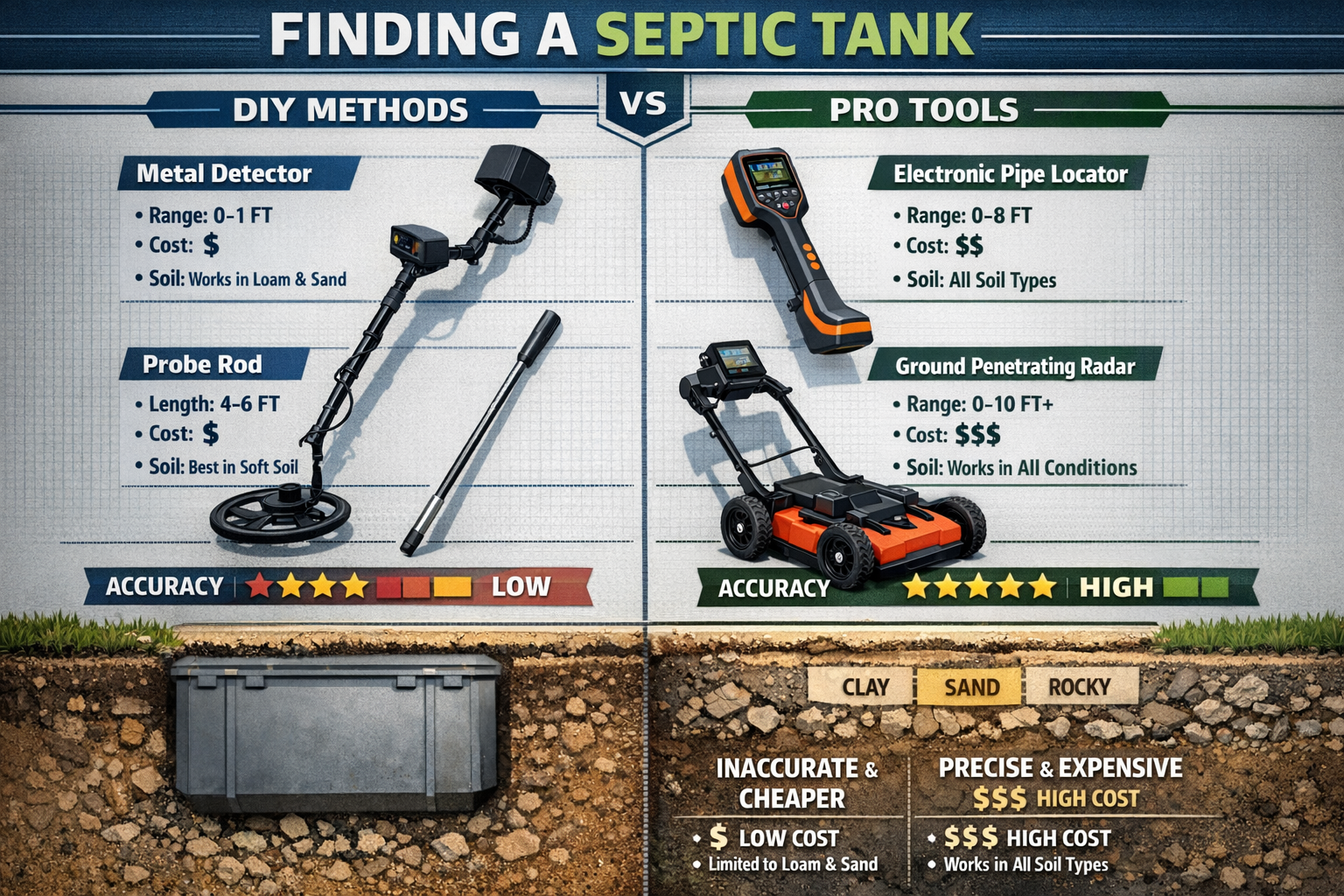
Metal detectors, probe rods, and electronic pipe locators are the most practical tools for homeowners to find septic tanks without hiring professionals. Each tool works best in different soil conditions and offers varying levels of precision.
DIY Detection Tools
Metal detectors ($50-$200)
- Detect metal access covers, rebar in concrete lids, or metal tank components
- Work well in most soil types
- Require systematic grid searching
- Best for tanks with metal components
Probe rods ($20-$50)
- Long, thin metal rods pushed into soil to detect solid surfaces
- Effective in soft soil conditions
- Require physical effort and patience
- Work at 1-3 foot intervals across suspected areas
Electronic pipe locators ($100-$500)
- Trace metal pipes or tracer wires
- Provide depth readings
- More precise than basic metal detectors
- Require some technical knowledge
Professional-Grade Equipment
Ground-penetrating radar (GPR) – Professional only
- Highest precision in dry or sandy soils
- Can map entire system layout
- Minimal surface disruption
- Expensive but comprehensive
Choose DIY tools if you have time for systematic searching and your property has accessible terrain. Choose professional equipment if you need precise locations quickly or have complex property layouts.
Common mistake: Don’t probe aggressively near suspected tank locations. Excessive force can damage pipes or tank components.
FYI: Some links may be affiliate links, which means I may earn a small commission at no extra cost to you.
While you’re maintaining your septic system, consider keeping it in optimal condition. Here are some of the most reliable septic tank treatment options for keeping your system clean, odor-free, and working properly—from breaking down waste and reducing buildup to helping prevent blockages and costly repairs. These easy-to-use tablets are trusted by many homeowners to maintain a healthy, efficient septic system with minimal effort.
👉 See how Septifix tablets can keep your septic system clean and efficient
How to Find Septic Tank Using Surface Indicators
Look for unnatural depressions, patches of greener grass, or areas where the ground feels different underfoot to identify potential septic tank locations. These surface clues often reveal underground tank positions without any digging.
Visual surface indicators:
- Grass patterns – Greener, thicker grass over the tank due to nutrient-rich soil
- Ground depressions – Slight sinking where soil has settled over the tank
- Raised areas – Mounded soil if the tank was recently installed or backfilled
- Different vegetation – Areas where grass type or growth rate differs noticeably
- Bare or thin spots – Places where grass struggles due to shallow soil over the tank
Physical surface clues:
- Ground that feels hollow when walked on
- Areas that stay wet longer after rain
- Spots where snow melts faster in winter
- Soil that feels softer or more compacted
Seasonal timing matters: Spring and fall provide the best visual contrast for grass patterns. Summer heat stress and winter dormancy can make differences more obvious.
Choose this method if your property has been established for several years and you can walk the entire suspected area safely.
Edge case: Newly installed systems may not show surface indicators for 1-2 growing seasons until vegetation patterns establish.
For more guidance on septic system maintenance once you locate your tank, check our septic tank maintenance tips guide.
When Should You Call Professionals to Find Your Septic Tank?
Call professional locators if DIY methods fail after 2-3 attempts, if you have complex property layouts, or if you need precise measurements for construction or major landscaping projects. Professional equipment provides accuracy that saves time and prevents damage.
Situations requiring professional help:
- Multiple failed DIY location attempts
- Rocky or heavily compacted soil conditions
- Properties with multiple septic systems
- Need for exact measurements and depth readings
- Construction or excavation planning near suspected tank areas
- Insurance or real estate transaction requirements
Professional advantages:
- Ground-penetrating radar pinpoints exact locations
- Electronic locators trace entire pipe networks
- Minimal property disruption during searching
- Detailed mapping of system components
- Written reports for official documentation
Typical professional costs:
- Basic location service: $200-$400
- Comprehensive system mapping: $400-$800
- Emergency location services: $300-$600
Choose professional services if accuracy is critical, time is limited, or your property has challenging conditions like rocky soil or complex layouts.
Common mistake: Don’t wait until you have a septic emergency to locate your tank. Professional services cost more during urgent situations.
What Safety Precautions Apply When Locating Septic Tanks?
Never attempt to open or enter septic tank access points during location efforts, and always call 811 (Dig Safe) before any excavation to mark underground utilities. Septic tank gases can be deadly, and surrounding utilities pose additional hazards.
Essential safety rules:
- Call 811 first – Mark all underground utilities before digging
- Never open tank lids – Septic gases can be fatal within minutes
- Avoid heavy equipment – Over tank areas until exact location is confirmed
- Use proper tools – Don’t use makeshift probes that could break underground
- Work with others – Have someone nearby when doing extensive searching
Hazard awareness:
- Methane and hydrogen sulfide gases in tanks
- Electrical lines near septic system areas
- Water lines that may cross septic pipe paths
- Unstable ground over old or damaged tanks
- Sharp objects or debris in soil around tanks
If you find the tank access:
- Mark the location clearly with stakes or spray paint
- Document measurements from fixed reference points
- Take photos for future reference
- Schedule professional inspection if needed
Choose extra caution if your property is older, has had utility work done, or if you’re unsure about underground hazards.
Edge case: Some older tanks may have damaged or weakened covers that could collapse under weight, even without opening them.
For information about recognizing septic system problems, see our guide on signs your septic tank needs maintenance.
How to Mark and Document Your Septic Tank Location
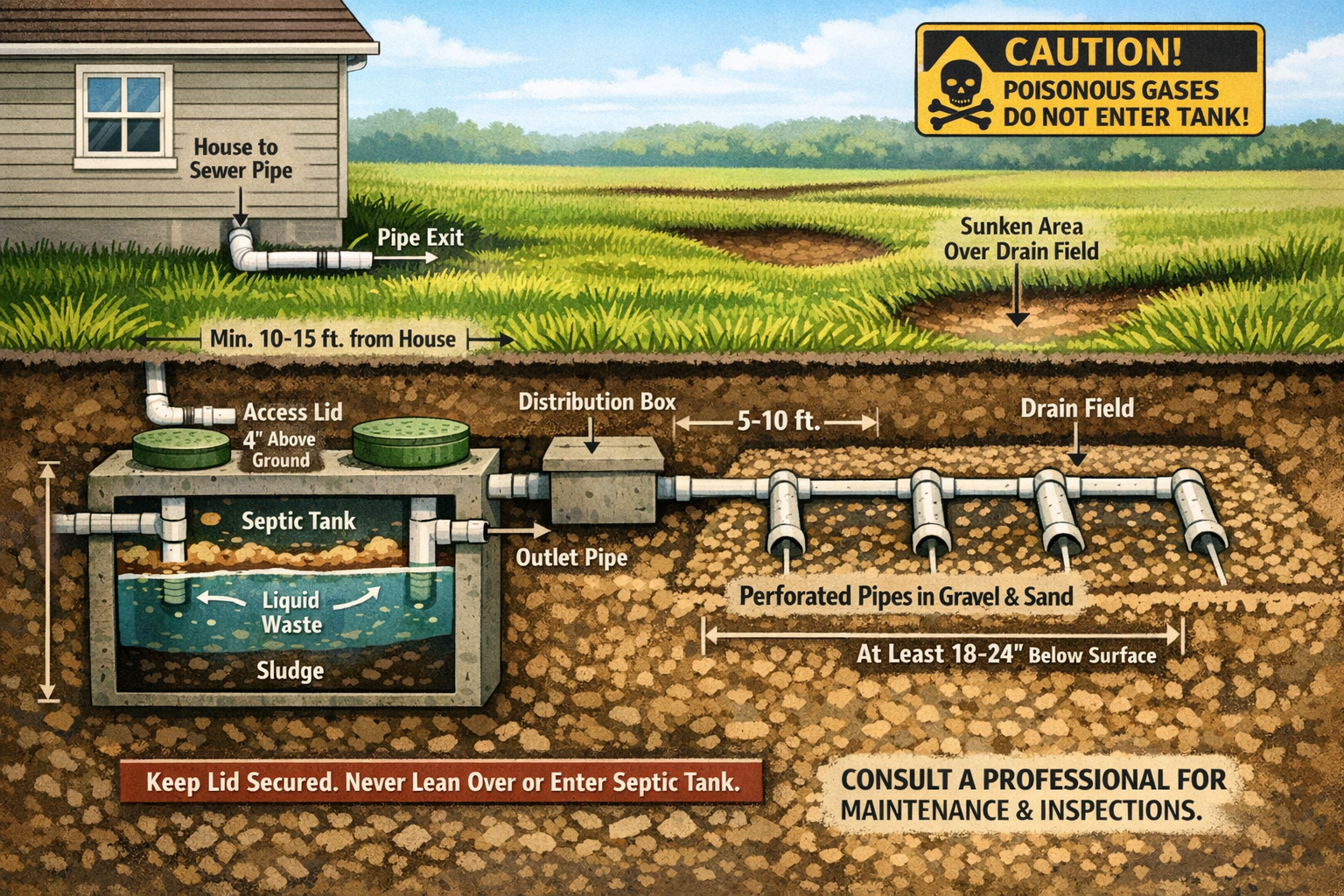
Once you find your septic tank, create a permanent record with measurements from fixed landmarks and mark the location for future access. Proper documentation prevents having to relocate the tank repeatedly.
Documentation steps:
- Measure from permanent landmarks – Use house corners, large trees, or property markers
- Record multiple reference points – At least three fixed points for triangulation
- Note depth information – If known from detection tools or records
- Take photographs – Show the marked location from multiple angles
- Create a simple map – Sketch the property layout with tank position marked
Permanent marking options:
- Metal stakes – Driven near but not over the tank
- Landscape markers – Decorative stones or posts
- GPS coordinates – Record exact latitude and longitude
- Spray paint – Temporary marking for immediate projects
- Property survey updates – Add tank location to official property maps
Information to record:
- Distance and direction from house corners
- Depth to tank lid (if measured)
- Access cover locations and sizes
- Distribution box location (if found)
- Date of location confirmation
- Method used for location
Choose permanent marking if you plan to stay on the property long-term. Choose temporary marking if you’re preparing for immediate maintenance or inspection.
Common mistake: Don’t place heavy markers directly over the tank access points. Keep markers nearby but not blocking future access.
Helpful Resource for Septic System Maintenance
Once you’ve successfully located your septic tank, maintaining its health becomes much easier. Regular maintenance prevents costly repairs and keeps your system running efficiently for years.
If you want a simple, effective way to maintain your septic system between professional services, consider using proven septic treatment tablets. These easy-to-use products help break down waste, reduce buildup, and prevent common problems like odors and blockages. Many homeowners find that regular treatment keeps their systems working smoothly with minimal effort.
👉 See how Septifix tablets can keep your septic system clean and efficient
For comprehensive maintenance guidance, check our best septic tank maintenance practices guide.
FAQ
How deep are most septic tanks buried?
Most septic tanks are buried 1-3 feet below ground surface, with access covers typically 6-12 inches below grade for easy maintenance access.
Can I use a regular metal detector to find my septic tank?
Yes, standard metal detectors can locate metal access covers, rebar in concrete lids, or metal tank components. They work best when used in a systematic grid pattern over suspected areas.
How far from the house is a septic tank usually located?
Septic tanks are typically positioned 10-25 feet from the house, following the path of the main sewer line. Local codes may require specific minimum distances.
What if my septic tank doesn’t have metal components?
Use probe rods to detect the solid tank surface, look for surface indicators like grass patterns, or consider professional ground-penetrating radar services for non-metal tanks.
Is it safe to walk over my septic tank once I find it?
Walking over septic tanks is generally safe, but avoid driving vehicles or placing heavy equipment over tank areas, especially if the cover condition is unknown.
How often should I locate my septic tank access points?
Mark your tank location permanently after finding it once. Check and refresh markers annually or after major landscaping to ensure access points remain clear.
Can heavy rain affect septic tank location efforts?
Yes, saturated soil makes probe rod detection more difficult and can obscure surface indicators. Wait for drier conditions for best location results.
What’s the difference between the septic tank and distribution box?
The septic tank is the large primary container (usually 1000+ gallons), while the distribution box is smaller and directs effluent to drain field pipes. Both need periodic access.
Should I mark my drain field pipes too?
Mark the general drain field area but avoid placing permanent markers over individual pipes. Focus on marking tank and distribution box locations for maintenance access.
Can I find my septic tank in winter?
Winter location is possible using records and metal detectors, but surface indicators like grass patterns aren’t visible. Snow melt patterns can sometimes reveal tank locations.
What if I find multiple tanks on my property?
Some properties have multiple tanks (main tank plus pump chambers) or abandoned old tanks. Document all locations and consult professionals to identify the active system components.
How accurate are property records for septic tank locations?
Property records provide good starting points but may not be perfectly accurate due to construction variations or system modifications over time. Use records as guides rather than exact locations.
Key Takeaways
• Start with documentation – Property records and permits often contain location maps or measurements that save hours of searching time
• Follow the sewer line path – Trace your main drain pipe’s exit point outward 10-25 feet to find the most likely tank location
• Use appropriate tools – Metal detectors work for tanks with metal components, while probe rods help detect any solid tank surface
• Watch for surface clues – Greener grass, ground depressions, or areas with different vegetation often indicate underground tank locations
• Prioritize safety always – Call 811 before digging, never open tank lids during location efforts, and be aware of underground utility hazards
• Document your findings – Create permanent records with measurements from fixed landmarks to avoid repeated location efforts
• Know when to call professionals – Complex properties, failed DIY attempts, or needs for precise measurements warrant professional locating services
• Mark access points clearly – Use permanent markers near but not over tank locations to ensure future maintenance accessibility
• Consider seasonal timing – Spring and fall provide the best visual contrast for identifying grass patterns and surface indicators
• Maintain your system regularly – Once located, schedule routine inspections and maintenance to prevent costly emergency repairs
For ongoing septic system care, explore our comprehensive septic tank maintenance guide and learn about how septic tank systems work.
References
[1] How To Find Septic Tank On Property – https://www.splashplumbing.com/how-to-find-septic-tank-on-property/
[2] How Professionals Locate Septic Tanks – https://www.lanikseptic.com/how-professionals-locate-septic-tanks/